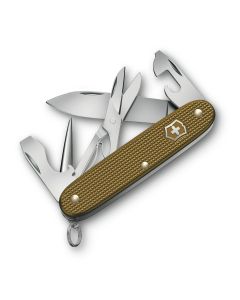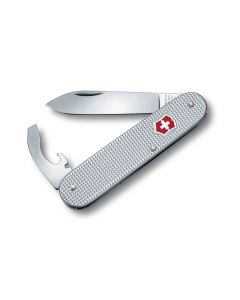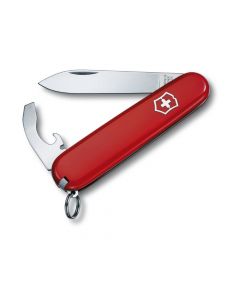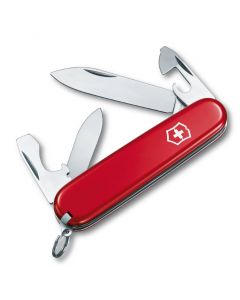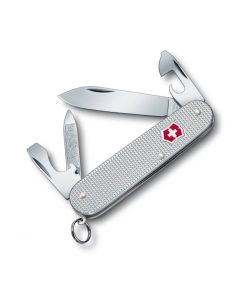
The Swiss-Knife Shop- Coutellerie du Petit-Chêne, situated in Lausanne - Switzerland, was opened in 1982. The choice is getting bigger, and in 1995, there are thousand of pocket knives : Switzerland: Victorinox and Wenger; France: Laguiole, Opinel, Nontron, Mongin, Le Pionnier, Nogent; Germany: Henckels, Dreizack, Herbertz, Hubertus, Linder; Spain: Marto, Martespa, Aitor; USA: Almar, Bear, Benchmade, Buck, Cold Steel, United Cutlery, Camillis, etc ---In 1998, we get into the web, with www.swiss-knife.com, produced by Netface SA, Lausanne. Since then we deliver around the world the famous Swiss Army Knives--- Our e-shop is actually the most complete on the web. In fact, by us you find the total swiss army knives range of both official manufacturers Victorinox and Wenger--Go shopping !search for your favorite pocket-tool,pouch, kitchen knife  etc...Swiss-knife-Heidi-Shop, www.heidi-shop.com. In this section you find a large range of typical swiss products : such as victorinox swiss army watches, mondaine watch, wenger watches,camel active,swatch... cuckoo clocks, pocket watches, t-shirts, gifts ...--Go shopping !


Official retailers of


Montres Optima SwissMemory Laser Pointer

OPTIMA


Swiss watches manufacturer with a great design

cuckoo swiss army knife

Franz Burgin
A Swiss Cuckoo


Victorinox develops the world’s smallest swiss flash white led swiss army knife

SwissFlash 16GB USB key White LED


EvoGiant

EvoGiant:

Biggest Swiss knife in the world, 141 functions !!

Alinghi and Wenger: a collaboration between two powerful Swiss teams

Alinghi and Wenger

- A collaboration between two big Swiss names !

Wenger Watch are developed to meet highest military standards the same way they serve you and me in our everyday life. Therefore, we construct our watches with the same devotion to quality and craftsmanship as Wenger manufactures the famous Swiss Army Knife for more than 100 years.-- Peter Hug, President-- Swiss chocolate, Swiss cheese and Swiss watches just like the Swiss Army knife, stand for quality

Wenger Watch are


developed to meet highest military standards...full collection 2008 !


Swatch Core Collection 2006
Swatch2008... ! Core Collection


New Kustom T-Shirts 2005-2006 Collection!
Kustom T-Shirts
boys-girls-kids & Sport
2008... !

swiss made


©2008 www.swiss-knife.com | www.heidi-shop.com | Swiss army knife shop | made in Switzerland | online since 1998

TRUE STORIES

TRUE STORIES : Read about people who have been helped in all manner of dangerous situations by their Victorinox pocket knife.

Preface

Victorinox book was written by people who have been helped in all manner of dangerous situations by their Victorinox pocket knife.

It is a source of pride and joy to us whenever we hear that our pocket knives have been used to save lives.

These pocket tools have proved their tremendous worth on numerous expeditions, including NASA shuttle flights into space, and in daily practical use all over the world.

We would like to thank everybody who has shared their experiences with us. Nowadays we also receive large numbers of e-mails telling us how and where the little helpers have come into their own. However, Victorinox only publishes incidents that are accurately verified, in particular those that are backed up by media reports

In short, our intention is to serve our fellow citizens with high-quality, practical products that are functional, dependable and good value for money. It is this endeavour that gives meaning to what we do and makes our work rewarding.

«Victorinox – my third hand»
It was late at night on 30 December 1999. It was raining as I drove along the minor road near to Paris that I had used hundreds of times before. It had been a demanding week. My alertness was blunted by Friday-evening tiredness, the to and fro of the wind screen wipers and the comforting knowledge that I was going home… then just one misjudged curve, sudden fright, like a bolt of lightning, and then the impact. My car had run off the road and landed in a ditch..

Pascal de Souza, technical director of an office that specialises in the study of parking facilities in cities, told us his story:

«In a few seconds I had come to my senses. I was up-ended and pressed against the steering wheel. I was trapped by my seat belt, which I could not unfasten. My car was stuck nose-down in a rainwater drainage ditch. The icy water was up to my waist and threatened to rise higher. Above, I could see the beams from the headlights of cars passing round the curve, but none of them could have spotted me… I had to depend on myself alone and in particular on my Victorinox. My pocket-knife, kept in its leather pouch on my belt, is never away from me. It is my faithful companion. It cut through the safety belt without difficulty, allowing me to struggle free of the car.

Without the Victorinox I would certainly have been left stuck all night at the bottom of the ditch, and in that icy cold water I might have expected the worst...»

Pascal de Souza’s story is just one example of how often life hangs on a single thread – in this case on the meticulously ground blade of a Swiss knife. Pascal de Souza goes so far as to say that the knife acted as his «third hand». And there would be some considerable truth in the claim. It has been part of his life for over 25 years. It is with him in both work and leisure.

Pascal de Souza also uses the Victorinox as an artist’s tool, since he employs it to carve wonderful sticks that he has collected or that friends have given him. «I look for pieces of wood that remind me of some kind of animal. I use my knife to underline and emphasise these forms. It takes me between 10 and 60 hours to do, depending on the complexity of the piece. I prefer hard, dense wood with a warm colour, such as box tree, olive or heather.» Qualities of wood that reflect his sturdy, ho nest hands. The hands of a master of Taekwondo, a martial art that concentrates on self-defence against attack:

«I’m preparing for the black belt. I like this sport because it isn’t aggressive or violent, and it can be used in any situation. It is an image of my Victorinox – a tool for life!»

Two children saved from drowning – with a pocket-knife
Chris Jamieson from Urenui, New Zealand, shows the Swiss Army Officer’s Knife with which he saved the lives of two children in April 1997 (taken 27 April 1997).

Jamieson saw a van leave the road and fall into the Awakino river. Thinking on his feet, he threw himself into the river and rescued the family of five. Two children in the back seat were trapped by their seat belts. They had to be cut free using the Swiss Officer’s Knife. Jamieson, a student, was hailed as a hero by the New Zealand police. The real «star» of the rescue, however, was the Swiss knife made by Victorinox.

A pocket-knife used as a scalpel.
A pocket-knife used as a scalpel On a domestic flight to Bangalore, India, a child was in danger of choking to death on a sweet that was stuck in his throat. Thanks, however, to a quickwitted doctor and the Victorinox pocket-knife, the child was saved. A similar incident happened on a Dublin street. In both cases lives were saved thanks to the knife from Ibach..

Passengers on a domestic flight in January 1976 witnessed the terrifying moments in which a young mother cried out for help in desperation because her child had swallowed a hard sweet and was in danger of choking. At first an attempt was made to rescue the child with an oxygen cylinder, but without success. Fortunately there was a doctor on the flight. The child was already in a critical condition, so he decided to carry out an emergency operation. However, the first-aid box on board did not have a scalpel. The hostess appealed urgently for a pocket knife over the loudspeakers. A passenger handed the doctor a clean, new and sharpened Swiss Officer’s Knife. The doctor quickly performed a tracheotomy. This courageous action saved the child. Shortly afterwards they landed in Bangalore and the child was rushed to hospital. There was not even an infection as a result of the emergency operation.

A roadside operation
The life of a nine-year old boy was hanging by a thread in June 1990.

Philip Byrne was spending his holidays with an aunt in Dublin, Ireland. While riding his bicycle to a carnival he was hit by a car. He was left lying in the road, badly injured – with internal injuries that could have cost him his life. By extraordinary coincidence a group of surgeons were travelling in the car behind. They operated on the boy on the spot using a Swiss pocket-knife and attached a drainage tube for the blood.

Philip has these doctors and the Victorinox knife to thank for saving his life.

The Himalayas – pocket knives to the top of the world
The Himalayas – pocket knives to the top of the world The Swiss knife has been taken on expeditions to the highest mountains in the world. It has been taken up the 8848-metre Mount Everest and up Anapurna in Central Asia. In 1970 Englishman Chris Bonington led the Anapurna South expedition. This mountain is the smallest of the 14 peaks over eight thousand metres high and, like Everest, lies in the Himalayas on the border between Nepal and Tibet. Following the successful expedition, Bonington sent a letter of thanks to the Elsener knife factory for its assistance, recounting the following story::

«Your support enabled us to climb the highest and steepest mountain face in the Himalayas. It was the most difficult mountain expedition in which I have ever participated. The extremely difficult conditions tested both climbers and equipment to the full. During the expedition the Swiss pocket-knives showed themselves to be excellent servants. They proved highly versatile, for example for cutting finger and toe nails high up the mountain, or filing down a spanner to the precise width required for repairing the seal on a leaking oxygen tank.

Withstood hammer blows

During our adventure I think we used every single blade on the knife except for the fish-scaling knife, there being a distinct shortage of freshwater fish halfway up the south face of Anapurna. The knives even stood up to blows from a hammer; despite this treatment the blades remained sharp. The kitchen and butcher’s knives were used extensively at our base camp. Finally, they had to deal with whole necks of mutton and I can assure you that Nepalese goats and oxen are amongst the toughest in the world.

At the end of our expedition the kitchen knives were a much sought after prize amongst our Sherpas and I think that the knives were just as sharp as they had been at the beginning of the adventure. Without your generosity, and that of other companies, we would not have succeeded in mounting this Anapurna South expedition. Once again, many thanks for your help.»

In another letter, Bonington thanked the company for its support of the British Everest expedition up the south-west face in 1975: «I would like to personally thank you once again for all the help you have given me over the years. As always, the Swiss knives proved their worth superbly. In fact, Doug Scott and Dougal Haston reached the top thanks to one of your knives. Doug used it to free Dougal’s oxygen system which had become blocked with ice. The only thing I regret is that I lost my own multi-purpose knife when I left the camp for one hour. I assume that one of the Sherpas swapped it for a more basic model…»

Jean Troillet from western Switzerland on Nanga Parbat in the Himalayas, 2002. He has also relied for many years on his faithful companions from Victorinox.

Jeep engine repaired in the desert
The Norwegian Tore Lund Bache has carried his Victorinox knife on travels around the world for more than 25 years. It was given to him as a gift in 1968 by his company, OSO. In July 1992 he wrote to Victorinox in Ibach and told them the story of a trip which, thanks to the knife, passed without serious consequences.:

«The knife has been my companion for 25 years and has travelled with me all round the world. I have always kept it in my left trouser pocket, even in my smoking jacket, ready for use at all times. The OSO company logo has almost completely disappeared. There are numerous stories involving this knife. It has become a legend among my friends, who are always asking me the same question: ‹have you got your OSO knife with you?› So I’d like to tell you one of these stories.

In 1969 I bought an old Willys Jeep, a Second World War model. It was a beautiful old vehicle and you could repair any of the parts (unlike today’s vehicles, on which broken parts have to be replaced). I took it for a spin into the desert at once, to try out the four-wheel drive. This test drive took me several kilometres into a marshy wooded area where no vehicle had obviously ever been before. And then my engine died.

The problem was that the fuel supply was no longer getting to the engine. Something was wrong with the fuel pump. There were no tools in my newly-acquired vehicle, and all I had in my pocket was a little loose change, a ballpoint pen and my Victorinox knife. With the help of the knife, however, I was able to scrape out and open the fuel pump. There were no screws on the pump, but I was able to use the knife’s bottle opener, which fitted the lid exactly.» «The suction valve in the fuel pump had broken into several pieces.

I used the knife to fashion a replacement part with the spring from the ballpoint pen. On reassembling the pump I was able to drive home. Although the knife hadn’t actually saved my life on that occasion it nevertheless enabled me to repair my vehicle. This saved me having to walk several kilometres and probably the trouble of finding a towtruck capable of towing the jeep back home.

Now, after 25 years of use, my knife is finally being retired. The spring locks on the blades are suffering from fatigue and the tool is worn out. That’s why last year I felt the time had come to buy a new pocket-knife. It simply had to be a Victorinox. Although it has the same shape, today’s models seem slightly longer and thicker and perhaps a bit stronger… I am happy with the quality of the new model. My only question: is the old model still available? It’s slightly thinner and shorter and so fits more easily into my pocket. In any case I will be sending you my old knife. As you can see, apart from the faults mentioned above and the signs of 25 years of use, it is still in very good condition. I would like to thank you for the excellent quality of your knives. They make ideal gifts and are a pleasure to use – whenever and wherever. Though, my wife doesn’t seem to appreciate it when I feel like doing my nails at the opera.»

Rescued from the night, the snow and the cold
In a letter dated 11 September 1975 José Louis Botti, an anthropology student from Buenos Aires, Argentina, describes how he survived a perilous situation. His Swiss knife, made by Victorinox, saved the day – and probably saved his life. This example also shows how much the owner of a Victorinox po cketknife places trust in this useful and practical tool and is keen to keep it in good repair at any price.

«I’m an anthropology student, specialising in archaeology. At that time I had another two projects to do before I could complete my studies. I was engaged as a project assistant while also working for an oil company. As you can imagine, my life is often spent in very remote areas with poor access. Most of the time I work by myself in the outdoors. Problems frequently arise which would be easy to solve in most cases if you had the right tool to hand. Unfortunately, however, you never do.

On a lonely road
For some years now, however, this has no longer been a problem, as I’ve had a Victorinox pocket18 knife as my constant companion. I always keep it at hand just in case I need it, which I frequently do; it does the job where other pocket-knives would have failed long ago. It goes without saying that it has always served me superbly.

But everything has its limitations. One particular day I was on a lonely road, without any food and night was drawing in. My car had become stuck in snow and there was the risk that I would freeze to death. With the help of my pocket-knife, however, I was able to saw through a branch some 15 cm thick to use as a lever for the car. Just as I had almost sawn through the thick branch the strain snapped the blade. However, because the saw had cut deep enough into the wood, I was able to lever the vehicle out of the snowdrift with the thick branch and continue my journey.»

Balloonist reaches world record height
Many stories involving the Victorinox pocket-knife are connected with travel and transport, be it by hotair balloon or mountain bike. Here we recount the two events which would have turned out very differently, or failed outright, if it had not been for the knife.

An article appeared in the famous London newspaper The Times on 7 June 1988 about a new world height record for hot-air balloon flights. However, Bertrand Piccard and Brian Jones made the first round-the-world flight by hot-air balloon in March 1999. They carried with them an Officer’s Knife and the Swiss Tool from Victorinox. the attempt very nearly failed and only got off the ground thanks to a Swiss Army Officer’s Knife, which the pilot of the balloon used to cut the ropes to two sacks of sand, allowing the journey skywards to begin. The following report was sent via the official channel of the Swiss Embassy in London to Victorinox AG in Ibach: «Lindstrand (the pilot) was born in Sweden but lives in Great Britain. Last year, together with the entrepreneur Richard Branson, he was one of the first pilots to cross the Atlantic in a balloon. Yesterday he succeeded in breaking the world height record following just a couple of false starts. In addition, because of high winds Lindstrand had to wait for more than a week to get a good start window.

Two forgotten sacks
Yesterday morning however, at 5.42 a.m., he set off 27 miles north of Laredo in a pressurised aluminium capsule. Weather conditions were ideal: blue sky with a light wind. The trickiest moment was at the start: due to an oversight, Lindstrand had failed to release two 100-pound sacks of sand. He had to climb down from his capsule and cut them off using a Swiss Army Officer’s Knife.The balloon, carrying the two adventurers, then flew up to the new world record height of 11 miles (17.7 kilometres). The Victorinox pocket-knife thus played an important part in the attainment of a world record for flying and physical endurance.

Four years in a purification tank
Gilbert V. Levin from the USA tells an almost incredible story in a letter dated 23 September 1991. This time it’s not about the Swiss knife saving a life or being used to rescue some hopeless situation, but about the little red knife itself having «survived» four years almost undamaged in a purification tank. Mr Levin wrote to Victorinox in Ibach:

«In 1973 I installed my new invention for sewage treatment at Seneca Falls, New York. One morning as I was crossing the bridge over the aeration tank of the treatment plant, I saw that the setting on one of the instruments was incorrect. I took out my dependable Swiss Army Knife to make the necessary adjustment. The knife slipped out of my hand and fell into the aeration tank. The function of the aeration tank in a treatment plant is to oxidise organic waste. This oxidising environment is very corrosive to metals.

A parcel in the mail
Four years later, in 1977, I received a small parcel by mail with a note from Al Hawk, the supervisor of the Seneca Falls plant. They had emptied the aeration tank and found my Swiss Army Knife at the bottom. The parcel contained the knife. It was in astonishingly good condition. The only thing wrong of any note was that the spring for the scissors was missing: it had dissolved. There was also some oxide on the aluminium parts that keep the blades separate. The plastic casing and cover had only suffered very minor damage near to the toothpick and tweezers. I intended long ago to send the knife back with my complements to the company which manufactures such durable knives. I have looked after the knife and since then have never used it. I enclose it for your attention as evidence to this almost incredible occurrence. I can assure you that very few products could have survived treatment like this, the components would have dissolved or simply disappeared.

Actually, I have wanted to write to you about this story for a long time but never got round to it. A similar article in the Wall Street Journal has now prompted me to write.»

A breakdown on a bicycle tour
Just how valuable a Swiss Army Officer’s Knife can be on a bicycle tour was illustrated by the following story from British Columbia, Canada::

«Erich Hensch was travelling with four friends on a 30-kilometre mountain bike tour in the Canadian forest. After about ten kilometres the chain on one of the bicycles broke. Since they didn’t have the appropriate tools with them, the repair was carried out using a Swiss pocket-knife. Using a large piece of granite rock as a hammer and the awl of the knife, the bicycle mecha nics struck the knife in such a way that its awl could knock the defective link out of the chain. The new link was inserted and the tour continued. The participants all agreed that without the pocket-knife the trip would have had to be abandoned.»

The astonishing thing, however, according to theletter written by Erich Hensch to the knife factory in Ibach, is that apart from a few small scratches, the pocket-knife has remained fully functional despite being struck with a piece of granite rock.

Now all my friends want one of these knives as well, wrote the sender to Ibach, enclosing an order with the letter.

Knife used to assist at a birth
During an extensive cycling tour around Lake Constance, a German optician bought a very special Victorinox knife: the so-called survival knife. This model is equipped with numerous tools and functions and can be carried on the belt in a leather bag. At first his friends and relatives laughed at him. By the end of the tour, however, following an experience which left a deep impression on everyone, he literally held all the aces. His brother-in-law wrote to Ibach with the following story:

«This special story of the Swiss knife began on a long cycle tour with my family. Right at the beginning of the tour my brother-in-law bought himself a particularly well-equipped Victorinox model – the survival knife, equipped with numerous tools and functions, which can be carried in a leather bag on your belt or in your trouser pocket. But after gently teasing my brother-in law about the knife, we soon forgot about it. When we stopped on the island of Mainau, however, that all changed.» A piece of nylon cord and a knife «On one of our longer walks we came to a summer meadow, where to our amazement a foal was being born – a far from everyday occurrence for us city folk. After the birth we noticed that the mother was ignoring her new-born, and that the foal didn’t get up on its feet. The umbilical cord was still connected..

None of the considerable number of people watching had any idea what to do. The animal warden who had hurried to the scene did not know what to do either, as he didn’t have the right equipment with him. That was my brother-in-law’s big moment. He took centre stage, carrying his survival knife. He quickly took out a piece of nylon rope and the knife, assisted the warden in tying the nylon rope around the umbilical cord, and with a deft cut finally released it.

The onlookers were overjoyed. The foal sprang up and trotted over to its mother, although less than stable on its feet. We should add that as my bro therin- law cleaned and put away his knife, nobody in our cycling party teased him for acting like a boy scout.»

Knife surgery in Uganda
The legendary Swiss Army Knife satisfies the most rigorous demands for quality, not least in the field of medicine. An example from black Africa makes his point impressively. On 18 September 1991 the Elsener knife factory received a letter from Professor John Ross, a Canadian doctor who was giving further training to local doctors in a rural region of Uganda. Shortly after his arrival his surgical saw was stolen. All he had left to carry out leg and arm amputations was his Swiss Army Knife. In his own words:

«I started work here two years ago. Part of my work is dedicated to the development of a hospital in a small town called Tororo. It is located close to the Professor John Ross holding the pocket knife that served as a surgical tool while in Uganda. Kenyan border, some 300 km from Kampala, the capital of Uganda. For my work I brought a wide range of surgical instruments with me, one of which was a good surgical saw for amputations. This type of instrument is needed here because many injuries occur here, such as bullet wounds, which result in having to amputate an arm or leg. Shortly after my arrival here the surgical saw was stolen. So my Swiss Army Knife, which I always carry with me, was sterilised in boiling water. From then on I decided to use the saw on the knife for amputations. It worked very well. It took an entire six months for me to get a new surgical saw. During this time I carried out at least six amputations using the saw on the knife. Although the knife lost its lovely red plastic cover due to being repeatedly boiled in water, the instrument otherwise worked faultlessly. I thought this information might be of use to you, and maybe for your advertising. You can tell people that the knife has a great scope of application because of the steel you use, which must be of excellent quality.»

Into space with the shuttle
The Swiss Army Knife is not only responsible for remarkable events on Earth but is also routinely carried into space: it is standard equipment for all American astronauts. In a letter dated 27 September 1985, the brother of an astronaut asks the Victorinox knife factory to send him a Swiss Army Knife. In a second letter he expresses his thanks for the «pleasant surprise».

«Please allow me to introduce myself. My name is Edward M. Payton of Rock Island, Illinois, USA. My brother is an astronaut and last year flew with the ‹Discovery› space shuttle. He took one of your pocket-knives with him: my brother flew with a Master Craftsman Swiss Army Knife as part of his equipment. He, and all the other astronauts, were given a knife like this so they could use it during their flight. My brother needed this knife for a number of tasks during the flight . He was full of praise for the Master Craftsman because it functioned well even under the difficult conditions of space flight – weightlessness.

When my brother visited us recently during a NASA holiday I discovered that he also needed his Swiss knife virtually every day here on Earth, on solid ground, so to speak. I was very impressed with this knife and have tried very hard to find one like it. However, I live in a small town in the Mid-West, have no access to a specialist knife shop, and don’t think that such knives are available here. I’m therefore taking the liberty of writing to you personally to ask whether I could purchase a knife like this from you, the same one that my brother used in the space shuttle. Can I buy a knife like this from you direct by post? If so please tell me the correct procedure for ordering. Many thanks for your trouble, I look forward to hearing from you shortly.»

Gift from Ibach
Shortly afterwards Mr Payton received a reply from Ibach, a small parcel containing the knife he wanted. He replied by return mail, sending thanks for the consignment: «Your superb knife has just arrived by mail. It was an extremely pleasant surprise for me. I wouldn’t have dared dream that you would send me a knife like this as a gift. You have my assurance that I will tell my brother about this and I am sure that he will pass this information on to NASA. You have been very generous. Thank you very much. Edward M. Payton.

From an interview for French TV with NASA astronaut Chris Hadfield
I was on board the space shuttle Atlantis. Our task was to dock with the Russian space station. It was my job to open the hatch of the shuttle so that we could enter the space station. I had to undo a lot of little screws, cut through cables and re-position the camera. And a lot of other things of that kind. My only tools were three small keys that the Russians had sent us. These sufficed for undoing some of the screws, but were not capable of doing all that I had to do. I was about to go back to the middle deck of the shuttle to fetch my big tool kit, but then I said to myself, But why not use the knife? Thanks to the Swiss Officer’s knife I was able to open the hatch.

Survived salt water
«Your Swiss Army Officers’ Knives coped super bly with extensive use. They soon became an indispensable tool for a range of tasks as well as in emergencies. Frank Goodman was very sad when he lost his on Cape Horn Island. I carried my knife in a lifejacket pocket and as a result it frequently came into contact with salt water. Despite this it continued to function perfectly. Many knives advertised as being ‹stainless steel› rust precisely when they are needed most. But not the Victorinox knives. These are obviously the genuine article. I would like to take this opportunity to thank you for your generosity. Without your help and those of others this adventure would have been impossible. Our success is your success.»

Round Cape Horn in a canoe
Tools and equipment carried on adventurous and often dangerous expeditions must be able to perform under any conditions. Everything can depend on them. Such undertakings include expeditions up the world’s highest mountains, deep into the rain forest, into outer space or barren deserts. They may also take place on the endless and unforgiving oceans. Tools must prove their worth, particularly where salt water quickly attacks and corrodes steel. An example of this was provided by a British group that sailed round Cape Horn in canoes..

The British adventurer Barry J. N. Smith expressed his satisfaction and delight to Victorinox AG in a letter dated 22 January 1978. His canoe expedition round Cape Horn had been a complete success, not least thanks to the pocket-knives carried on the expedition. In Smith’s own words::

«We left Puerto Williams on 11 December 1977 and rounded Cape Horn eleven days later. As you can imagine we experienced numerous exciting situations as we paddled around the Woolaston Group. We identified a whole range of fauna and flora and both our team and our equipment were put to the test in a unique environment. I am delighted to send you an expedition report together with slides which show your knives in action.»

On the North Pole expedition
As well as daring expeditions up high mountain peaks, steep cliffs and into undiscovered deserts, ventures to the icy wastes of the Poles among Man’s greatest challenges. But even here you’ll find them – Swiss Army Knives from Ibach.

As, for example, during an exhausting North Pole expedition in the winter of 1976-77. Charles Burton reported in early 1978 on the British North Pole expedition. During the winter of 1976/ 77 his team was on route to the most northerly point on the globe during the dark Arctic night. They had to abandon the expedition just before reaching their destination due to the harsh weather. However, it had made sufficient progress to furnish a couple of heroic stories in which the Swiss Army Knife played a prominent role. Burton recounted in his letter to Ibach:

«In July 1977 we returned to England after six months in the Arctic. The group of ice explorers spent 90 days on the pack ice at temperatures below 50 degrees Celsius. This had been the lowest recorded temperature in the Arctic for 46 years. On 15 May, despite having already covered 890 miles (1432 km) on the ice and just ten days away from the North Pole, we had to be evacuated at once. A breakup in the ice, something which had never happened before, forced us to return. The ice broke up early, as it had never done before, and forced us to turn back. Despite this we were one of the expeditions that succeeded in travelling far to the north that year. The Swiss Army Knives you supplied us with proved invaluable for the entire group on the ice as well as for those at base camp. They were used, among other things, to remove ice from the sledge runners and for opening cans of food.

When one of our party fell into the ice we were able to use the knife to cut his clothing loose and free him from his wet garments which immediately froze. When he fell into the ice the temperatures were minus 37 degrees Celsius, so he had to be taken into a tent quickly and dried out. Without acting quickly, thanks to the help of your knives, he could have been in serious danger.»

Repairs in space
In May 1991 the Discovery space shuttle set off on one of its flights into near space. As always, each of the astronauts carried a Victorinox pocket-knife as part of their personal equipment. On this particular mission an expensive experiment would have failed if the ‹little red tool› hadn’t got the astronauts out a jam. The remarkable story was even reported in detail in Le Figaro, the world-renowned French newspaper.

During the mission it was discovered that a piece of recording equipment was no longer functioning properly. The task of this piece of equipment was to record data from two telescopes for use in experiments. On the sixth day of the nine-day mission, Ground Control in Houston, Texas worked out a solution to the problem. A new cable connection was required to a sophisticated computer. In order to carefully strip the insulation from the wires, the astronaut used a Victorinox Army Officer’s Knife. The computer was successfully re-connected and the vital data rescue.

Very standard knives
As the spokesman for the mission, James Hartsfield, explained, the Victorinox Army Officer’s Knife is standard equipment for all astronauts. ‹We give each astronaut a Swiss Army Officer’s Knife and they carry it with them on board. It’s been with every mission right from the outset.› The knives made for the astronauts at Victorinox are no different to the standard pocket-knives anyone can buy. In Hartsfield’s words: The knife accomplished its task well.»

Equipment repaired in the Space Lab
In 1983 the German Ulf Merbold became the first non-American to go into space on a space shuttle. A piece of luck as it turned out for NASA, since Merbold rescued experiments costing countless millions on board the space shuttle with the help of his penknife. He was celebrated as a hero in the German press, as can be seen from the following report in the illustrated «New Review»:

«Let’s not get carried away. However, we are right to be just a little bit proud of our fellow countryman in space. Ulf Merbold, 42, a father of two, performed a small miracle. On the ten day flight on the US Space Shuttle «Columbia» he came to the rescue of a series of important experiments totalling several hundred million marks. All he needed for this was a Swiss knife and natural German thoroughness.

How did Merbold come to be up in space? The physicist from Stuttgart received a free place on the flight as a service in return, so to speak, for the financing by Europe of Space Lab to the tune of 2 billion German marks and for its being constructed in Bremen. Together with a second payload specialist his task was to carry out 72 experiments in the laboratory – at a height of 250 kilometres and a speed of eight kilometres a second.

The wrong kind of wrench
It became evident during the very first days that things in the expensive laboratory need fixing, just like they do in an apartment. Things went wrong. And then came Ulf Merbold’s finest hour. As he started to open his first piece of equipment it became obvious that he had been sent into space armed with the wrong kind of wrench. Merbold solved the problem using his Swiss pocket-knife. Shortly afterwards there was a failure in the reflector furnace, part of an experiment to manufacture alloys of metal in space under weightless conditions at 1600 degrees. Merbold’s knife had a screwdriver to suit the purpose. Finally he used the knife to repair the electrical plug which had been incorrectly connected to the base. The United States, watching every move via satellite TV, was delighted: a genuine handyman in space.

Compliment from the commander
Even the commander of the Columbia, moon landing veteran John Young, who was initially rather distant, was impressed with his passenger. ‹That guy over there› he said to the Ground Control Station, ‹has really been slogging his guts out and he doesn’t even have a good window seat.› Through Merbold (and thanks to Victorinox) Europe had indeed played its part in space travel»

Freed from a burning lift with a knife
A mind-boggling story from Oregon, with the Victorinox pocket-knife playing the «leading role». A man became stuck in a lift fire and it was only thanks to a Swiss Army Knife that he was able to free himself from the smoke and confined space. This resulted in a boom in Victorinox knife sales in the city. The person involved recounted the events in detail in a letter to Victorinox. By remarkable coincidence his name was MacIver.

«I am a 31-year-old engineer, living in Portland, Oregon, USA, and what I have to offer is more than just an exciting story. The main actors are myself and a Victorinox Swiss Champ. I am writing this letter not to seek fame or honour but to pacify my friends and my family who have been pestering me to send this account of events to you..

Wine, beer, money and art
I’ve carried a Victorinox ‹Champ› around with me or many years. It has proven its worth in no end of situations but never more so than on the evening of 3 December 1992. On that evening my wife Morgan attended a Christmas Art-bizarre party (bizarre was the right word). The party was hosted by the tenants of the Mattox Building (1231 NW Hoyt St.). This building houses various studios for photographers, designers, architects etc. I went to the fourth floor of the building, the top floor, where the party was being held and stayed for about an hour. Needless to say, after an hour I became bored and went looking for something more interesting. There are three ways to travel up an down the Mattox Building: a stairwell, a goods lift and a passenger lift. This passenger lift is as old as the building itself which, I imagine, is mentioned somewhere in the last chapter of the Bible. The lift is about one square metre in size and about 2.5 metres high. The inner door consists of a metal sliding grille, the outer one is a very normal door. There is no telephone or escape hatch..

As I was travelling in the lift it began to slow down and fill with smoke. A few seconds later it came to an abrupt halt. I was alone and trapped. The lift continued to fill with smoke. Because there wasn’t much fresh air I had to breathe in the black, acrid smoke whilst the built-in loudspeaker went on playing a violin sonata in the background. The lift had stopped on the mezzanine, just above the first floor. I was able to see approximately ten centimetres of the lift doors on the second floor and almost the whole of the doors on the mezzanine. People gathered on the second floor. They started to talk to me through the lift doors. But we couldn’t see each other. Once they learned that the lift had jammed and I was in danger of slowly but surely choking to death, they called the emergency control centre.

No escape route
Meanwhile my friends on the fourth floor noticed the smoke. They quickly realised that someone was stuck in the lift and that a fire had broken out in the lift shaft. They attempted to force open the doors on the second floor to release me. A whole contingent of the Portland Fire Department then arrived. The problem for my rescuers was that at some point over the years the mezzanine had been sealed up. There was no way of reaching the lift doors on the mezzanine – my only escape route. Since no-one could reach me I did what I could to
reach them. The mechanism responsible for opening the mezzanine doors had also been put out of action because the floor was no longer in use. Someone had removed the lift door button which had once been there for opening the doors. Otherwise I could have simply pressed it to get out..

Knife came to the rescue
Then I remembered my trusty Swiss Army Knife with its pair of tweezers. Three minutes later I had removed the nuts on the door and was at last able to get out of the lift. But now I was trapped in the dead space of the mezzanine. Meanwhile, the battalion of Fire Department people (four large fire appliances, two ambulances and two control vehicles) had put out the fire in the lift shaft and was still trying to reach me. They had battered down doors to reach the floor of the shaft and climbed to the roof of the building to reach me from above.

The police had cordoned off the entire block which had since filled with curious onlookers. I could hear alarm bells ringing and sirens wailing. But there was a window on the mezzanine and that’s where I was finally rescued from and where my martyrdom came to an end. Before then, of course, I had used my Champ once more to remove the hinges from the window. However, in the heat of the moment I left my highly-prized knife on the mezzanine. As the fireman accompanied me down the ladder, the crowd below applauded and I waved. Friends and reporters were waiting for me below. Luckily, a fireman found my knife and returned it to me..

Epilogue
The next morning a radio station telephoned me and interviewed me live. They had read about me in the newspaper and found it amusing that not only had I broken out of a jammed lift and escaped the fire but that my name is MacIver (MacGiver is the name of an American TV hero who repeatedly escapes from hopeless situations, usually with the help of a Swiss Army Knife). So they ‹forced me›, still half asleep, to recount my experience on the radio. In the weeks that followed the Swiss Army Knife was one of the most popular Christmas gifts in Portland: ‹the type of knife used by the guy to free himself from the lift›. I bought the last Swiss Champ in a shop for a friend and noticed that it was on display in the window. The shop owner told me that he had had a run on Swiss Champs following the incident. My parents-in-law were in another shop and told the owner they knew me. He then showed them
the newspaper cutting on the incident which he kept in his wallet. He explained to them that every child who had come into his shop wanted to buy a knife just like the ‹lift escape knife›. Life really is exciting. Yours, Douglas MacIverr.»

American admiral’s life saved
The Victorinox knife repeatedly turns up in stories about aircraft. In one case, following a tragic crash, it enabled a passenger to free himself from the burning wreckage. On another occasion the little red knife saved an American admiral’s life by being used to repair an oxygen mask. Without this he would have crashed into the Atlantic. Reports on these events were received at Ibach.

Seat belts cut through
The following happened to Helmut Knosp from Freiburg in Breisgau, Germany::

«On 31 March I crashed into the French Voges on a flight from Reims, France to Freiburg in a four-seater sporting aircraft. My three companions were killed on the spot. I escaped with a few broken bones in my arms and legs and other minor injuries. My life was saved thanks to a Swiss Army Officer’s pocket-knife made by your company. With the help of the knife I was able to free myself from the crumpled, burning machine by cutting through the seat belt and then cutting my way through the plastic trim and forcing my way out of the window. Since then I have named the knife, my constant companion for many years, ‘my lifesaver’ because without it I would no longer be alive.»

Oxygen mask repaired
The Army Officer’s Knife from Victorinox also saved the life of an American admiral, on this occasion over the Atlantic. The high-ranking officer wrote to Ibach saying:

«I have carried my Victorinox friend with me since I started flying 23 years ago. One dark night, in 1988, halfway across the Atlantic I needed it to repair the broken oxygen mask. If I hadn’t had the knife with me I would have been left with no choice but to fly much lower to enable me to breathe. However, this would have meant that the fuel would then not have been sufficient to reach the airport on the Azores (because of increased air resistance). I could have remained at high altitude, but this would have been very dangerous as I could have passed out through lack of oxygen. Neither alternative was a tenable option. Thanks to your super knife I was able to complete my flight safely and as planned.»

In 1966 a female American customer sent a Victorinox knife to Ibach for repair and wrote: «Our son bought this knife eight years ago in Switzerland. He was ten years old and it was his first trip to Europe. He had earned the money for it himself and the knife was all that he wanted to bring home from Europe. The following Summer he took it on a camping trip
to a site on the Canadian border where he lost it. He was obviously very upset by this. The next Summer he returned to the camp and found the knife purely
by accident when diving in quite deep water. He could hardly believe it because it was still in the same condition as it had been when he lost it the year before. So you can understand why we would very much like to have it repaired.»

Cockpit window repaired
The second story involves a knife which travelled thousands of kilometres on journeys all round the world and continued to give good service.

«Although it has taken me a long time to get round to sending this letter, I would like to thank you for repairing my knife. It was returned in 1975 in almost the same condition as when I purchased it in 1959», writes Milton B. Mann in his letter to the world-famous company in Ibach.

«This is tremendous service and I cannot tell you how pleased I am with it. This knife represents a unique piece of my life history. It has accompanied me on numerous journeys through 71 countries, has travelled millions of kilometres with me and has been used for almost every task you could possibly imagine. Recently for example, during a refresher test I had to pass as a pilot, the examiner pointed out to me that one of the screws on the cockpit window was loose and he couldn’t close it. The wind was blowing into the cockpit. I told him that there was a screwdri ver on my pocket-knife. But he replied that he needed a Philips screwdriver, a special tool for this kind of screw. The examiner was amazed when I showed him my pocket-knife which also had this particular kind of screwdriver attachment and the problem was solved.»

Luggage of diplomats
The «little red knife» from Switzerland is not only standard equipment for astronauts, adventurers and craftsmen; it has also achieved diplomatic status. B.C. Hill, Australian Consul in Dublin, wrote to the Victorinox company to thank them for a consignment of pocket-knives that have made apparently successful gifts for his relatives. He wrote:

«Please find enclosed another order for eleven pocket- knives. I hope you don’t think I’m acquisitive or an obsessive collector. I can assure you however that these knives are for myself and my close family relatives – I might add that I have a large family. My cheque is enclosed. I would be grateful if you could send the knives as soon as possible.

Indispensable on journeys
You might like to know why I’m so interested in your knives. I first came across Victorinox knives in Switzerland when I was General Consul in Geneva and from 1964 and 1969 as permanent representative for the European Department of UNO. Since then my personal knife, a ‹Traveller› (which I am now replacing) has been a constant companion. I find this pocket-knife extremely practical since my work often requires me to fly from one end of the world to the other. When I arrive I frequently have to change the plugs on my personal electrical equipment, put up tie racks etc. My pocket-knife serves me extremely well.

Tried and tested in Vietnam
My knife has proved indispensable on my travels. It’s impossible to keep a toolbox to hand when travelling by plane. Your knives have offered the best alternative in this situation and shown themselves to be useful in other ways for my son-in-law. Until recently he served as a career officer in the Australian Army; in this capacity he served in Vietnam for
a year from 1965 to 1966. Before he returned to the Far East I sent him one of your knives, a ‹Champion›. He later told me that this knife had been indispensable to him during his twelve-month active service, particularly on jungle patrols.» «In fact, the knife was so popular with his comrades that he had to keep an eye out to make sure he did not ‹lend› it to his Australian and American bro thers in arms for longer than was necessary.»


Symbol of Switzerland
Armbrust Schweizer Woche, the organisation that promotes Swiss products and services, carried out a survey through the media to determine what symbol the Swiss considered most synonymous with quality. The choice was between the logos of the PTT and Swissair, the Swiss passport and the Swiss Army Officer’s Knife.

The Knife emerged as the clear winner. Top-class advertising for the Swiss Army Knife has also been given through one of the world’s foremost and best-known technology enterprises: NASA. In 1978 the American space organisation ordered 50 Victorinox Master Craftsman Swiss Army Officer’s Knives (model 5044). NASA stipulates that their order may not be commercially linked with the name of NASA without permission. The organisation is however happy to allow reference to be made in Victorinox publicity material that the knife from Ibach is part of their astronauts’ standard equipment.


It’s even become an objet d’art
The legendary Swiss knife from the firm of Victorinox in Ibach-Schwyz has not only saved lives, dealt with emergencies and been carried in the trouser pockets of adventurers but has actually become an «objet d’art». The design itself is evidently capable of distinguishing itself: world-class, irrepressible and able to span the generations.

In the words of J. Stewart Johnson, Curator for Design at the Museum of Modern Art in New York, in his letter to the manufacturers in Ibach: «I am pleased to inform you that at our meeting of 28 November 1977 our Architecture and Design Department has decided to include your Swiss Army Officer’s Knife in our collection.»

Allowed for advertising purposes
The letter from the Museum continues: «If you would like to mention in your documentation that your knife has been included in our Architecture and Design Department, please use the following text: ‹included in the Design Collection at the Museum of Modern Art, New York›. It is the policy of our museum that this kind of information may not be used as advertising text. In plain language the name of the museum must not be mentioned in connection with advertising but simply in order to illustrate a fact. You will no doubt appreciate our position in this respect.» It is logical in itself that the inclusion of the Swiss Army Knife in the museum catalogue is good enough advertising.